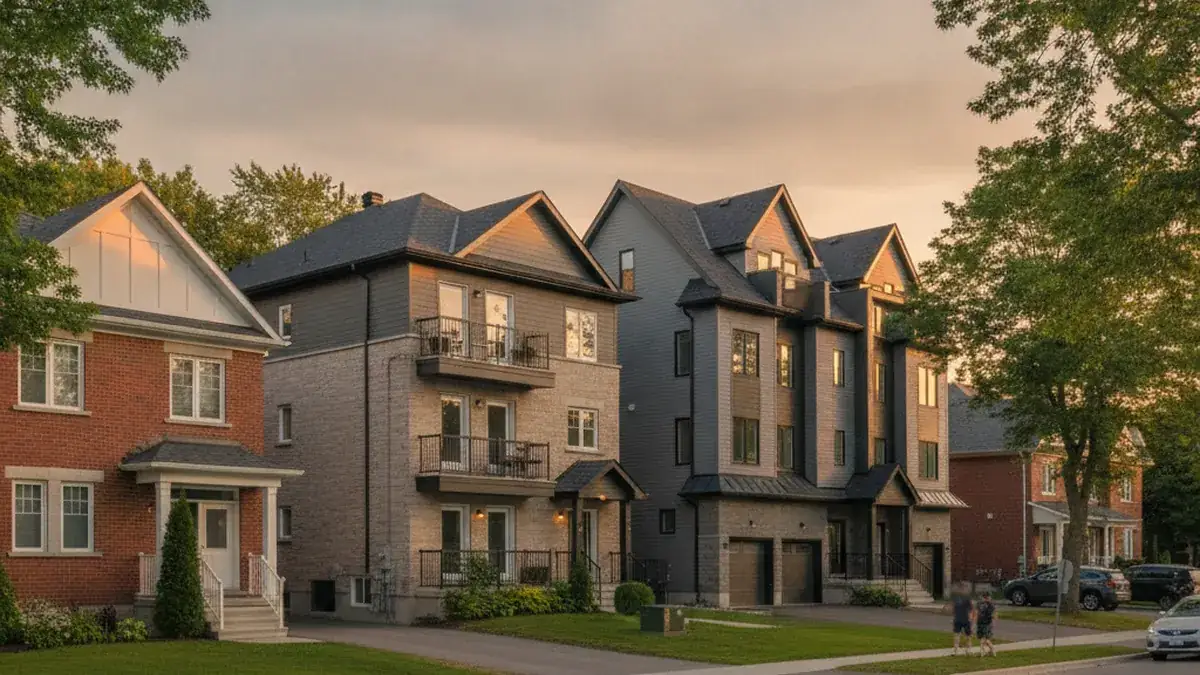
An easement or an encroachment on a plex lot can seem harmless — until a notary flags it on the eve of closing. For an owner of an income property on Montreal's North Shore, understanding these charges on the land matters as much when buying as when selling: they determine what you can do with your yard, your parking and your structures, and they can influence both price and financing. Here is a practical guide to the main types of easements, to fence and shed encroachments, and to how you detect and resolve them.
What is an easement on a plex lot?
An easement is a charge imposed on one lot (the servient land) for the benefit of another immovable owned by a different person (the dominant land), under articles 1177 and following of the Civil Code of Quebec. It runs with the land and stays in force after the plex is sold.
The Civil Code of Quebec defines an easement as a charge that ties two neighbouring immovables: one bears the burden (your plex lot), the other benefits. The key point for an income-property owner is that the easement is real — attached to the land, not to a person. When you buy or sell the plex, the easement stays. You inherit the seller's easements, and the buyer will inherit yours.
An easement is usually established by title (a notarial deed published in the Land Register), sometimes by the destination of the owner. Contrary to a common belief, a continuous and apparent easement can no longer be acquired by mere prolonged use under the current Civil Code: a written instrument is generally required. That is why documentary verification is so important.
What types of easements affect a plex?
On the North Shore as elsewhere in Quebec, a handful of easement families show up constantly in plex files:
- Right of way — a neighbour has the right to cross your lot, on foot or by vehicle, often to reach an enclosed lot or rear parking. This is the easement most likely to reduce the usable area of your yard.
- View (and non-view) easement — the Civil Code governs openings (windows, balconies) facing the neighbour. An easement may authorize a view that would otherwise be prohibited, or restrict future openings.
- Public-utility easements — for Hydro-Quebec, water, sewer, gas or telecommunications networks. They let the entity install and maintain its infrastructure and may prohibit any permanent construction within a strip of the lot.
- Drainage or water-flow easement — common between two lots at different elevations; the lower land must receive the water that flows naturally from the higher land.
- Tolerance or encroachment easement — created specifically to regularize a structure that overhangs (see below).
| Type of easement | What it allows | Impact on a plex |
|---|---|---|
| Right of way | Neighbour crosses your lot | Can eat into yard or parking — check the route |
| View / non-view | Governs windows and balconies | Limits certain openings or facade renovations |
| Public utility (Hydro, water) | Install and maintain infrastructure | Often bans construction within a given strip |
| Drainage / water | Natural water flow | Frames landscaping and grading |
| Regularized encroachment | Tolerates an overhanging structure | Secures title — useful before selling |
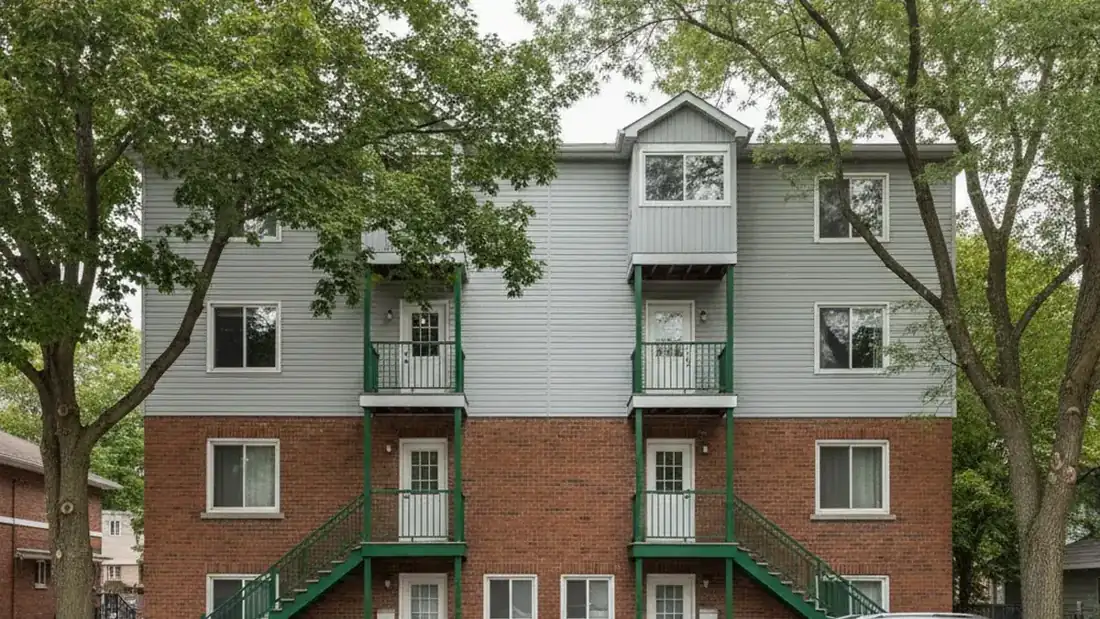
What is a fence or shed encroachment?
An encroachment is a structure — fence, shed, deck, wall — that overhangs, partly or fully, onto the neighbour's lot without any right authorizing it. Unlike an easement, it is not a published right but a fact to be regularized.
Encroachment is the most common land problem on a plex, because it often stems from small actions: a fence put up "by eye," a shed placed too close to the line, a deck or porch rebuilt slightly wider. The neighbour may have said nothing for years — but the irregularity resurfaces the moment an up-to-date certificate of location is required for a sale.
The Civil Code (articles 992 and following) distinguishes by scale and good faith. If the encroachment is minor and in good faith, the encroaching owner can generally regularize it by acquiring the encroached parcel or obtaining an easement. If the encroachment is substantial or in bad faith, the neighbour may demand forced acquisition of the parcel, damages, or, in extreme cases, demolition. Demolition remains the exception, but the threat is often enough to complicate a transaction.
The classic trap before a sale
A shed or fence that encroaches shows up on the up-to-date certificate of location. The buyer's notary, who must guarantee clear title, may then require a correction, an easement or a holdback — and the buyer's mortgage lender may suspend financing until it is fixed. Discovering the encroachment the week of closing means risking a collapsed sale.
How to detect an easement or encroachment?
Three sources complement one another. None is enough on its own, but together they give a reliable picture of your plex lot:
- The certificate of location — prepared by a land surveyor, it shows the lot boundaries, the building footprints and any visible encroachments, and notes known easements. It is detection tool number one. To read it well, see our guide on the certificate of location when buying a plex.
- The Quebec Land Register — the index of immovables and published deeds reveal easements established by title. The title deed and the prior purchase deed normally mention existing easements.
- A visual inspection of the lot — walk the lot line: a fence that does not follow the survey markers, a shed hugging the boundary, a Hydro-Quebec pole or transformer, a path used by the neighbour are all signals.
The reflex to build
- Require a recent certificate of location (under 10 years old and post-dating the latest work).
- Request a copy of the title and check the index of immovables in the Land Register.
- Match what you see on the lot with what the documents say.
- When in doubt, consult a land surveyor or notary before signing.
How to resolve an encroachment before selling?
The good news: most fence or shed encroachments are settled amicably. The usual routes, from simplest to heaviest:
- Move the structure — if the fence or shed is easy to pull back onto your own lot, this is often the fastest and cheapest fix.
- Negotiate an encroachment (or tolerance) easement — through a notarial deed published in the Land Register, the neighbour accepts that the structure stays. Title becomes clear for the buyer.
- Buy (or sell) the encroached parcel — a transfer of a small strip of land, with a cadastral update by the surveyor, settles the boundary permanently.
- Release an extinguished easement — if an old easement no longer serves any purpose, a notary can have it struck off to clean up the title.
For a seller in a hurry, the issue is the timeline: regularizing takes time (surveyor, notary, the neighbour's agreement). That is one reason some owners choose to sell their North Shore multiplex to a buyer who knows these files and works with an imperfect situation, rather than wait months for a boundary correction.
Reading a certificate of location: where easements and encroachments hide
The certificate of location is the densest and most misunderstood document in a plex file. Many owner-sellers file it away without ever opening it — then discover, at the worst possible moment, that it spelled out in black and white the encroachment now blocking the sale. Spending thirty minutes decoding it saves you weeks of stress at the notary's table.
A certificate of location has two inseparable parts: the plan (the drawing of the lot, the buildings and their distances to the boundaries) and the report (the land surveyor's written text, often more revealing than the plan itself). Never read one without the other.
What the plan shows you
On the plan, first find the lot line (the official boundary of your land, usually a solid stroke) and compare it to the footprint of each building and accessory structure. Distances are given in metres. A shed, deck, balcony or fence whose stroke crosses the lot line — or that shows no setback — is an encroachment signal. Conversely, a hatched strip along a boundary often marks an easement: public utility (Hydro-Quebec, water), right of way or drainage.
| Symbol or mention | What it means | Seller's reflex |
|---|---|---|
| Continuous solid stroke | Official lot line | Reference for measuring any encroachment |
| Hatched strip along a boundary | Easement (Hydro, water, right of way) | Check the matching deed in the Land Register |
| Structure crossing the line | Encroachment onto the neighbour (or theirs onto you) | Measure the extent, plan a regularization |
| Missing setback figures | Building possibly too close to the boundary | Ask the surveyor to clarify |
| "Subject to…" note | Easement or right not drawn but existing | Read the full report |
What the written report reveals
The surveyor's text lists the easements found in the titles, describes the encroachments observed and flags possible non-conformities (insufficient setbacks, zoning deviations). That is often where — not on the drawing — the decisive sentence sits: "the wood fence encroaches 0.3 m onto the neighbouring lot" or "the lot is charged with a right of way for the benefit of lot X." Read every paragraph, highlight each mention of an easement or encroachment, and put your questions to the surveyor before, not during, the transaction.
Three questions to ask your surveyor
- Does the certificate reflect the current state of the lot, or have structures been added or moved since?
- Is each easement mentioned published in the Land Register, or is it a de facto situation?
- Is there any encroachment, even minor, likely to make the buyer's notary react?
Searching the Land Register: the index of immovables step by step
The certificate of location illustrates; the Quebec Land Register proves. Every easement established by title is published there, along with the notarial deed that creates it. For an owner-seller, knowing how to consult the index of immovables before listing your plex means eliminating the bad surprises that make a buyer back off.
- Find your lot number. It appears on your municipal tax bill, on the certificate of location and on the purchase deed. It is the entry key to the Register.
- Consult the index of immovables. On the Land Register's online portal, the index lists, in chronological order, every published deed affecting your lot: sales, mortgages, easements, releases.
- Spot the easement entries. Easement deeds carry an explicit mention. Note the registration number of each one.
- Order the copy of the deed. The full text specifies the location of the burden, the nature (right of way, view, public utility) and the properties involved. Online consultation is available for a per-document fee set by the Land Register.
- Cross-check with the certificate of location. Every published easement should appear, in one form or another, on the plan or in the report. An easement in the Register that is absent from the certificate — or the reverse — deserves verification.
Reference: Quebec Land Register — products and services (consulting the index of immovables and deeds).
The "forgotten easement" trap
An easement published thirty years ago remains enforceable against the buyer, even if no one has exercised it for years. Until it is struck off by a notarial release, it charges your plex. Never assume an old easement is "dead" because it is unused: have a notary check it.

Special cases: continuous, apparent easements, party walls and enclosed land
Not all easements behave the same way, and these Civil Code distinctions have concrete consequences for what you can — or cannot — do with your plex lot. Here are the main ones.
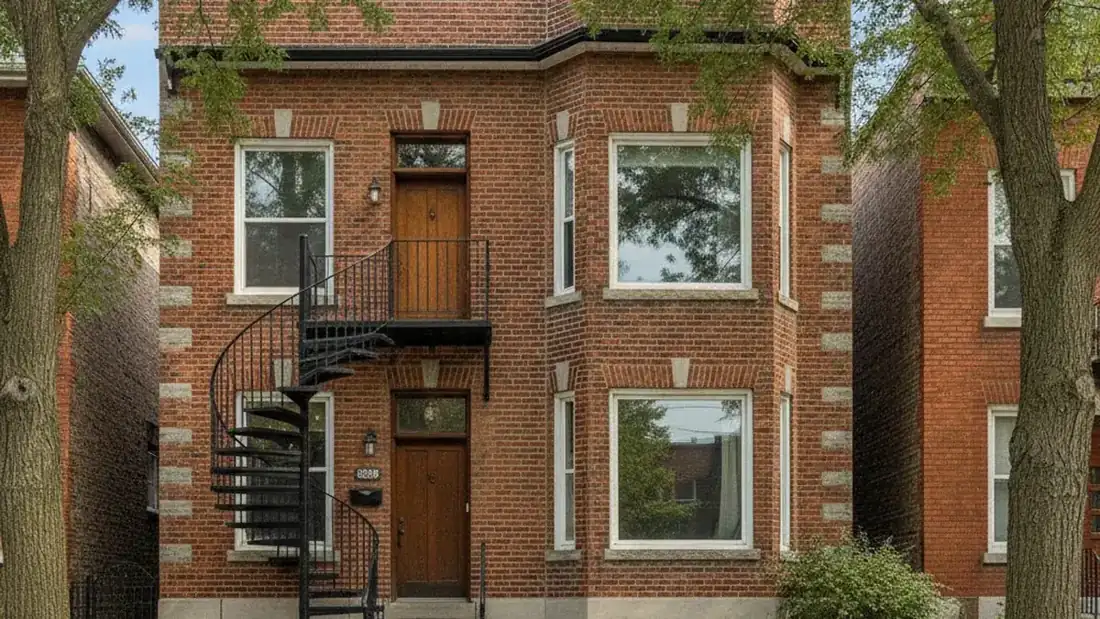
Continuous or discontinuous, apparent or non-apparent
An easement is continuous when it is exercised without current human intervention (a sewer pipe crossing the ground, a right of water flow) and discontinuous when it requires an action each time (a right of way a neighbour drives across). It is apparent if a structure reveals it (a path, a pole, a visible pipe) and non-apparent if nothing signals it on the ground. The non-apparent easement is the most dangerous for a seller: invisible to the eye, it surfaces only in the Land Register — hence the importance of the documentary search.
| Distinction | Example on a plex | Why it matters at sale |
|---|---|---|
| Continuous | Water pipe crossing the yard | Limits construction over the burdened strip |
| Discontinuous | Neighbour's vehicle right of way | Reduces the real use of the parking |
| Apparent | Path, pole, visible transformer | A buyer notices it at the showing |
| Non-apparent | Published no-build easement | Invisible: detected only in the Register |
The party wall
A party wall or fence belongs to and serves both neighbours, who share its upkeep. On a plex built up to the boundary (common in central areas), a party wall is not an encroachment: it is a co-ownership regime for the wall. Distinguishing it from a true encroachment avoids "correcting" a situation that is, in law, perfectly regular.
Enclosed land and the right of way
Enclosed land — with no adequate access to the public road — gives its owner the right to demand a passage over the neighbouring lot, in exchange for compensation. If the plex you are selling borders an enclosed lot, a savvy buyer will want to know whether such a right of way exists or could be claimed. Conversely, if your own plex depends on a passage over the neighbour, that right must be clearly titled: a buyer will not finance a building whose access rests on a verbal agreement.
Prescription: what changed
Contrary to a stubborn belief, you can no longer "win" an easement simply by exercising it for years: under the current Civil Code, an easement is established by title, not by prolonged possession alone. Conversely, an existing easement can be extinguished by non-use for ten years. This asymmetry matters for a seller: the passage your neighbour has used "forever" without a published deed may not be a right — and an old easement recorded in your titles may be extinguished. In both cases, only a notary can settle it.
"An easement is extinguished if it goes unused for 10 years." Once extinguished by non-use, it does not revive, even if use later resumes.
Éducaloi — releasing yourself from an easement (interpretation of the Civil Code of Quebec)Sources: Éducaloi — buying property and releasing an easement; Civil Code of Quebec (LégisQuébec).
Common mistakes with easements and encroachments
- Assuming an old easement is extinguished. Ten years of non-use can extinguish an easement, but it must be established and published; do not assume it without a notary's opinion.
- Installing a fence without checking the markers. Setting a fence "by eye" is the number-one cause of encroachment. Have the boundaries located before the work.
- Ignoring a Hydro-Quebec easement and building a shed on it. The entity can require removal of any construction that hinders maintenance of its infrastructure.
- Waiting for the offer to discover the problem. An expired certificate of location revealing an encroachment mid-transaction is the worst scenario. Keep in mind the legal warranty against latent defects: an undisclosed encroachment can fuel a dispute.
- Settling verbally with the neighbour. A verbal agreement does not bind the future owner. Only a published notarial deed protects the buyer — and you, the seller.
Three worked examples on a North Shore plex
Concepts come alive in dollars. Here are three situations typical of a North Shore plex owner, with orders of magnitude that show how an easement or encroachment can affect a transaction. The amounts are teaching examples: each real file depends on the extent, the location and the neighbour's attitude.
Scenario 1 — The fence that encroaches 0.4 m
You are listing a triplex in Blainville. The up-to-date certificate of location shows your yard fence encroaching 0.4 m onto the neighbour over about twelve metres. The encroachment is minor and in good faith. Two routes are open to you:
- Move the fence to the correct side of the line: the cost of materials and labour, a few hundred to a few thousand dollars depending on length, but the title becomes spotless.
- Negotiate a tolerance easement with the neighbour, recorded in a notarial deed and published: notary and surveyor fees, but no demolition. The neighbour agrees the fence stays.
In both cases, the cost of the fix (often under $3,000) is trivial compared to the risk of a buyer knocking several thousand dollars off — or walking away — over a clouded title. Regularizing before listing is almost always the winning move.
Scenario 2 — The right of way that eats into parking
Your quadruplex in Terrebonne offers four rear-yard parking spaces. But the index of immovables reveals a right of way for the benefit of the rear neighbour: they may cross your yard to reach their garage, on a strip that in practice neutralizes one space. You go from four to three usable spaces.
| Element | Without the easement | With the easement |
|---|---|---|
| Usable parking spaces | 4 | 3 |
| Appeal to a tenant with a car | High for all 4 units | One unit without a dedicated space |
| Buyer's negotiating argument | None | Reduced potential parking revenue |
Here you do not "fix" the easement: it is legal and published. The right strategy is to document and present it honestly, showing that three spaces remain functional and that the easement prevents neither renting nor resale. A buyer told in advance negotiates less aggressively than one who discovers the easement at the last minute.
Scenario 3 — The shed on the Hydro-Quebec easement
On your duplex in Saint-Jérôme, a shed was installed years ago in a strip charged with a public-utility easement for Hydro-Quebec. The entity can require removal of any construction that hinders maintenance of its infrastructure. The shed, technically, is a prohibited construction within the burdened strip.
Before selling, two steps are needed: move the shed out of the burdened strip (often the simplest fix for a movable shed) and document the removal. Leaving the problem to the buyer invites them to demand a price cut — or to watch their lender suspend financing pending clarification.
The logic common to all three scenarios
- An encroachment on your side can be fixed (move it, easement, buy the parcel).
- An easement you are subject to is documented and presented, not "repaired."
- In every case, acting before listing costs less than absorbing an anxious buyer's negotiation.
Regularizing an encroachment: the detailed procedure and its timeline
Settling a fence or shed encroachment is not complicated, but it takes time — and time is exactly what a seller in a hurry lacks. Here is the full process, step by step, with the realistic delays to expect.
- Establish and measure. A land surveyor confirms the exact extent of the encroachment from an up-to-date certificate of location. Expect a few days to a few weeks depending on the surveyor's availability.
- Choose the settlement route. Move the structure, negotiate an easement, or buy/sell the encroached parcel — the choice depends on the extent, the cost and the neighbour's willingness.
- Approach the neighbour. A frank conversation settles most cases. Present the situation with the certificate in hand, without drama: a minor good-faith encroachment is not a conflict, it is a formality to correct.
- Have the deed drafted. The notary prepares the easement or the parcel transfer. If a parcel changes hands, the surveyor produces a technical description and a cadastral operation.
- Publish in the Land Register. The notarial deed is published: that publication is what makes the agreement enforceable against the future owner and "clean" in the eyes of the buyer's notary.
| Step | Who | Realistic delay |
|---|---|---|
| Up-to-date certificate of location | Land surveyor | 2 to 8 weeks |
| Agreement with the neighbour | You (and the neighbour) | A few days to a few weeks |
| Drafting the deed | Notary | 1 to 3 weeks |
| Cadastral operation (if transfer) | Land surveyor | Several weeks |
| Publication in the Land Register | Notary | A few days |
All told, a simple regularization wraps up in a few weeks; a parcel transfer with a cadastral operation can take several months. That is exactly why some owners choose to sell their North Shore multiplex to a buyer who accepts the situation rather than tie up their plex during the process.

Impact on value, financing and title insurance
The question that haunts every seller: "Will this lower my price?" The answer depends entirely on the nature of the charge. A routine easement often has no effect; an unresolved encroachment, however, can cost dearly in price, delay and financing headaches.
Effect on value
- Routine public-utility easement (Hydro-Quebec, water): generally no effect on a plex's value. Buyers and appraisers treat them as normal.
- Right of way that eats into a real use (parking, yard): can justify a price reduction proportional to the use lost.
- Unresolved encroachment: the most penalizing, because it creates uncertainty over title — and uncertainty, in real estate, is always paid for with a discount.
Effect on mortgage financing
The buyer's lender requires clear title and a compliant certificate of location. A visible, unresolved encroachment can lead the institution to suspend or refuse financing until the situation is corrected. For a plex, where the loan also rests on income, a parking space neutralized by an easement can even marginally influence the lender's analysis. Fixing it upstream removes a blocking reason from the buyer's file.
Title insurance, a backup policy
When a formal regularization would take too long, title insurance can sometimes let a transaction move forward by covering the risk tied to a known title defect, such as a minor encroachment. It does not replace a real correction and is not always available for major defects, but it is a tool the buyer's notary can propose. Discuss it with your notary: it is sometimes the key that unlocks a signature.
What really makes a buyer back off
It is not the existence of an easement — it is the surprise. A buyer who discovers an encroachment the week of closing feels misled and negotiates hard, when they do not walk away. The same buyer, told in advance and reassured by a regularization plan, carries on calmly. Transparency protects your price.

Neighbour relations: from amicable agreement to court

Nine encroachments out of ten are settled over coffee with the neighbour. But you should know the full ladder of remedies, if only to gauge the value of settling amicably — always faster and cheaper than litigation.
- The direct conversation. The first reflex. A minor good-faith encroachment is almost always corrected by agreement, without a lawyer.
- The formal notice. If the neighbour refuses to cooperate, a formal letter describes the situation, the right invoked and the correction requested, with a deadline. It marks the seriousness of the step.
- Mediation. A neutral third party helps the parties find common ground, often cheaper and faster than a trial.
- Court action. As a last resort, the court decides: forced acquisition of the parcel, an imposed easement, damages, or — exceptionally — demolition if the encroachment is substantial and in bad faith.
For an owner-seller, the moral is simple: an ongoing neighbour dispute is a deterrent for the buyer and the lender. Better to settle, even by giving a little, than to sell a plex with an unresolved conflict attached. A "clean" file is worth more than a "winning but litigated" one.
Document, always
- Keep a copy of every certificate of location, old and recent, to show how the lot evolved.
- Keep written agreements with neighbours — a verbal agreement does not bind the future buyer.
- Note the dates: an easement extinguished by ten years of non-use is proven with dated photos, testimony and documents.
The seller's checklist before listing
Before you list your plex, run this "land" file through the sieve. Every box ticked in advance is a reason to back off removed from the buyer and their notary.
Your "easements and encroachments" verification list
- Recent certificate of location (under 10 years old and post-dating the latest work) in hand.
- Index of immovables consulted; every published easement identified and understood.
- Consistency verified among the lot, the certificate and the Land Register.
- Any encroachment on your side corrected or being corrected (move, easement, transfer).
- Neighbour agreements recorded in a notarial deed and published.
- Extinguished easements that are release candidates flagged to your notary.
- File ready to present to the buyer: transparency = trust = protected price.
A plex lot whose easements are understood and whose encroachments are resolved sells faster, at a better price and with less stress. This is the kind of preparation that separates a smooth transaction from a sale that derails in the final week.
In short: a well-identified easement is not a flaw, it is a data point to fold into your valuation; an unresolved encroachment, on the other hand, is a concrete risk to price, financing and the time it takes to sell your plex. Detect early, document, regularize — and you approach the purchase or sale of your North Shore income property from a position of strength.
Sources: Civil Code of Quebec (LégisQuébec) — easements (art. 1177 et seq.) and encroachments (art. 992 et seq.); Éducaloi — real estate law and neighbour relations; Ordre des arpenteurs-géomètres du Québec (land surveyors); Chambre des notaires du Québec. Informational content — not a substitute for legal advice.


